Alzheimer’s disease and other forms of dementia have devastating effects, not just on memory and cognitive function, but also on activities of daily living that are negatively impacting by changes in the brain. As these diseases progress, the needs of patients will change, often necessitating more products to assist in caregiving.
Chief on the list of concerns regarding the dementia patients is their tendency to wander and get lost. If not quickly found, victims can suffer injuries along with dehydration and other health risks. Safety and Wander alarms that allow wanderers to be tracked and found quickly are vital. Newer designs include bracelets or wristbands with a built-in flash drive that stores medical and contact information along with the patient’s name, enabling any needed medical attention to be delivered promptly.
|
The Parentgiving Alzheimer's store contains many Alzheimer's games, puzzles, and ideas. The R.O.S Therapy Systems’ Alzheimer's products are a wonderful way for Alzheimer's patients and those who are bed or wheelchair bound to enjoy stimulating games—and for grandchildren and/or adult children to join in on the fun.
At its heart of these Alzheimer's activities is the activity tray itself, ready to make playing favorite games both stable and easy. Choose from peg solitaire or knight games, craft boards or clipboards for puzzle books, a gardening, craft, or “sorter” board, which keeps small crafting objects separate and safe, as well as magnetic puzzle boards with nostalgic puzzle themes with pieces that aren’t easily lost.
36 Items : Starting at $17.99
|
Eating can be a challenge with Alzheimers. These special dishes and other daily living aids make life more enjoyable.
17 Items : Starting at $13.95
|
|
Protecting the safety of an Alzheimer's or dementia patient is always top of mind. From safety strips to hand mitts, these items can help.
16 Items : Starting at $14.99
|
Wandering is one of a caregivers greatest concerns. These devices help alert you when a door is opened or when the patient gets up from a bed or wheelchair. Read our Buyers Guide for help finding the right safety alarm.
18 Items : Starting at $19.99
|
This sensitive and discreet monitor allows you to detect movement from someone in a bed, chair, room or doorway. The chime can be set to sound at the monitor or send a signal to a small receiver that can be mounted or placed up to 100 feet away.
If the pin connector is pulled from the alarm, the alarm will sound. The activation cord adjusts from 18 to 36” and clips to the patient's clothing. This alarm secures to a chair or bed with a clip or included hook-and-loop fastener and has two volume levels, 85 db or 100 db.
Alimed's alarm attaches to a door frame. Just place the signal unit in the door jam and the alarm will be activated when the door is opened. It’s loud enough to be heard anywhere in the home.
Alzheimer’s disease and other forms of dementia have devastating effects on activities of daily living as well as memory and cognitive function. As these diseases progress, patients’ needs change, and this often places more strain on caregivers.
Perhaps the most serious concern regarding the dementia patient is their tendency to wander and get lost. If not quickly found, victims can suffer serious injury along with dehydration and other health risks. Safety alarms alert caregivers to patient movement, enabling you to keep better track of their whereabouts. This is especially important at night, so that you can rest easier and not lose the sleep you need to function well.
Safety alarms come with different alarms and alarm mechanisms. The right one is the one that fits your circumstances and doesn’t increase agitation in your loved one.
Bed alarms, chair pad alarms and seat belt alarms are three of the most common types of designs. There are also different activation systems, the mechanism by which the alarm is set off:
A wireless alarm emits a large, invisible “curtain” that provides a wide area of protection. Look for a unit that mounts easily and has a swivel bracket to adjust the monitoring beam. This is a great option for securing an area without attaching an alarm to your loved one or their bed or chair.
A pull-cord alarm should easily secures to a bed or chair with a clip and feature a pin-style activation cord that is pulled when the user moves; this dislodges the pin from the alarm unit to activate the signal.
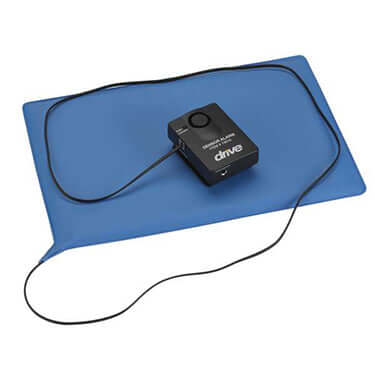
A pressure-sensitive alarm sounds when a patient gets up from the bed or chair it was placed on. A pressure-sensitive pad usually connects to an audio alarm.
Some pads such as the Sling Seat Wheelchair Alarm are made specifically for wheelchair use and certain styles require that the alarm be mounted onto the wheelchair with a bracket.
Another option for use in a chair is a seat belt alarm that sounds when the belt is unbuckled. One style is a breakaway lap cushion—if the wearer stands up, the magnetic strap releases on one side of the lap cushion, activating the alarm.
One type of alarm, the Patient Locator Alarm, keeps track of patients prone to wandering—the unit attaches to the wanderer to signal their location to the caregiver.
A totally different option involves alarming doors in the home. Usually this approach includes a brightly colored strip or banner that serves as a visual barrier, not a barricade, to direct the patient away from the doorway or an off-limits area; if he or she tries to leave through the door, the alarm is activated.